
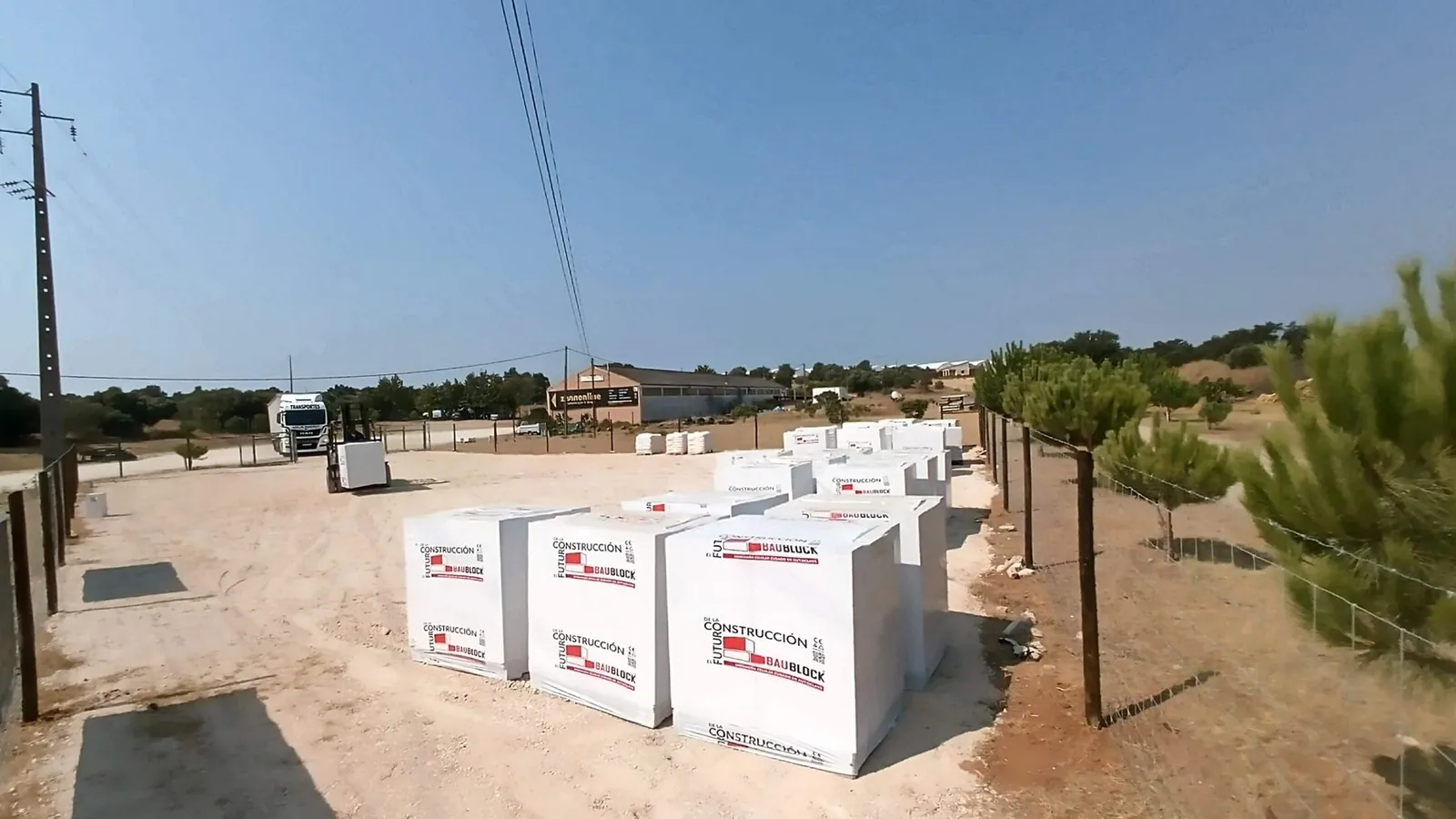
AAC in Practical Terms
AAC stands for autoclaved aerated concrete. The material is deliberately made porous, which reduces density while retaining a solid mineral structure. BAUBLOCK’s environmental declaration covers AAC with production densities between 350 and 600 kg/m³; the BlocoCelular product range uses different density classes to suit different wall functions.
For a project team, the attraction is not one headline number but the combination of relatively low weight, accurate block geometry, mineral composition and useful thermal performance. Factory dimensions allow thin joints and straightforward cutting, which can simplify setting out and service routes when the wall is designed around the system from the beginning.
Why the BAUBLOCK Families Are Different
AAC is a material category, not a single interchangeable block. BAUBLOCK separates the range into families because density, thickness and intended use change the behaviour of the wall. TERMECO is the lower-density external-wall family in the product range, UTILITAS increases density and strength for external walls, and SILENSO uses a higher density for internal partitions. O-TEC and U-TEC are shaped components used for project-specific details rather than general wall infill.
- TERMECO: external-wall AAC where lower density and thermal performance are priorities.
- UTILITAS: external-wall AAC with a stronger balance of strength, mass, thermal and acoustic performance.
- SILENSO: higher-density AAC intended principally for internal partitions.
- O-TEC and U-TEC: shaped blocks for specific reinforced or opening details; project drawings govern their use.
What the Declared Numbers Mean
Product declarations list values such as density, compressive strength, thermal conductivity and reaction to fire. They are useful specification inputs, but they do not describe the finished building on their own. A declared thermal conductivity value belongs to the block material; the U-value of a completed wall also depends on thickness, finishes, junctions and thermal bridges. Likewise, Euroclass A1 describes reaction to fire of the material, while a wall fire-resistance classification belongs to a tested or assessed wall assembly.
AAC in the Algarve & Alentejo
For projects in Portugal, the practical discussion normally includes summer heat, thermal bridges, solar exposure, render systems, service integration and the selection of compatible blocks, mortars and shaped pieces. That is why BlocoCelular.com is more than a price list: the aim is to connect the product family, technical documents, product availability planning and the actual construction detail.
Technical statements on this page are based on the BAUBLOCK declarations, environmental declaration, supplied U-TEC drawing and/or TERMECO 200 fire report available in the project documentation.